During January 2026, the Alumni Committee of Gokhale Institute of Politics & Economics organized three major alumni-centric engagements: TEDxGIPE 2026, Alumna-Connect (in collaboration with the Placement Cell), and the Alumni Dinner.
The committee’s focus for the month was on fostering academic discourse, strengthening professional engagement, and enhancing alumni–student interaction through a series of focused, high-impact events.
TEDxGIPE 2026:
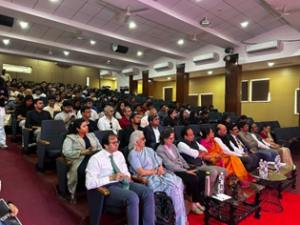
TEDxGIPE’26 was organized by the Alumni Committee at Kale Hall under the theme “The Hum of an Avalanche: Sense. Spark. Shift.” The event brought together an eminent panel of speakers from academia, industry, policy, and consulting, offering diverse perspectives on economics, technology, education, and societal transformation. Notably, five of the six speakers were alumni of the Gokhale Institute of Politics & Economics, underscoring the strength of the institute’s alumni network and its continued engagement with the institute’s academic and intellectual ecosystem

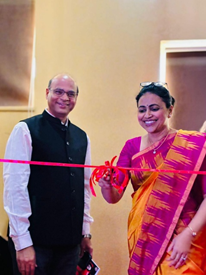 The event formally commenced with an inaugural ceremony graced by the Chief Guest, Rasika Chikte Gupta, and the Vice Chancellor, Dr. Umakant Dash. The inauguration was marked by the traditional lighting of the lamp, accompanied by a Saraswati Vandana, lending a solemn and auspicious beginning to the proceedings. This was followed by the formal felicitation of the Chief Guest by the Vice Chancellor. The GIPE Music Committee then presented a musical performance, setting a dignified and ceremonial tone for the event.
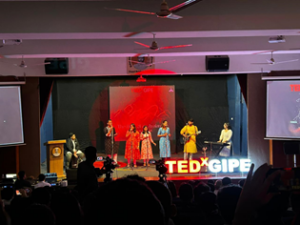
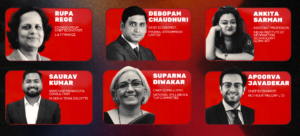
The speakers for TEDxGIPE 2026 are Apoorva Javdekar, Rupa Rege, Ankita Sarmah, Saurav Kumar, Debopam Chaudhuri and lastly, Suparna Diwakar.
Speaker 1: Apoorva Javadekar
Dr. Apoorva Javadekar opened the TEDx conference by drawing attention to a critical yet often invisible barrier to India’s economic momentum: misallocation. Challenging the common assumption that India’s primary constraint is a lack of resources, she argued that the underlying “hum” of the country’s economic struggle lies not in the scarcity of capital, but in its inefficient distribution.
The presentation centered on a striking comparison between India and the United States. Despite India having a higher capital-to-GDP ratio (4.10) than the United States (3.15), its output per worker hour remains significantly lower—$7.86 (PPP) compared to $85.56. This disparity, she explained, is a direct consequence of misallocation, wherein unproductive firms—often referred to as “zombie firms”—continue to survive, absorbing resources that could otherwise be directed toward more innovative and high-growth enterprises.
Dr. Javadekar further identified key systemic frictions that hinder the process of “creative destruction,” which is essential for dynamic economic growth. These include rigid labour laws and distorted credit markets that restrict the expansion of productive firms while enabling inefficiencies to persist.
A key takeaway from the talk was the immense potential for growth without additional investment. She estimated that simply reallocating resources from low-productivity to high-productivity firms could enhance India’s total factor productivity by 40 to 60 percent. By modernizing labour regulations, expediting liquidation processes, and leveraging the “Payment + Information Revolution”—including UPI and Account Aggregators—for cash-flow-based lending, India can transform the subdued hum of misallocated capital into a powerful engine of inclusive growth.
Speaker 2: Rupa Rege Nitsure
Dr. Rupa Rege Nitsure explored the “hum” of an avalanche through the lens of macroeconomic signal detection. In an environment characterized by constant data noise, she emphasized that the ability to identify “silent vibrations”—subtle signals embedded within fiscal and monetary trends—is critical for institutions seeking to navigate uncertainty before it escalates into a crisis.
For Dr. Nitsure, the “Spark” represents the moment of insight when an economist or policymaker discerns meaningful patterns within this noise. She illustrated this through the evolution of India’s banking sector, noting that transformative developments—such as the integration of banking structures—often originate from a single, rigorous inquiry into improving systemic stability.
The final “Shift,” she explained, occurs when such insights translate into momentum, reshaping outcomes and redefining the broader economic landscape. Her talk ultimately reframed the role of the economist—not merely as an observer of past trends, but as an architect of future possibilities. By linking large-scale economic transitions to the everyday decisions of businesses and individuals, she demonstrated how clarity and foresight can channel the latent force of an “avalanche” into a directed and constructive engine for growth.
Speaker 3: Ankita Sarmah
Ankita Sarmah opened her talk by challenging conventional notions of progress. In a landscape often defined by “unicorn” valuations and high-profile IPOs, she argued that meaningful systemic change begins far more quietly—in the unseen spaces where pressure builds before an eventual breakthrough.
Ms. Sarmah described the “hum” as that persistent sense of discomfort or inefficiency that individuals often come to accept as normal. Moving beyond the traditional economic triad of land, labour, and capital, she introduced a fourth factor: the ability to recognize patterns of inefficiency and ask, “What if the system itself could function differently?”
She drew a compelling distinction between “business” and “entrepreneurship.” While business seeks to answer, “Will this sell?” entrepreneurship, she suggested, is driven by a deeper question: “Will this matter?” Through examples such as greenhouse farming-in-a-box and real-time transit data solutions, she emphasized that while profit serves as fuel, impact remains the ultimate destination.
The “avalanche” of change, she concluded, rarely announces itself dramatically; instead, it begins with an individual choosing to question and act upon a problem others have normalized. She left the audience with a powerful reflection: when confronted with a broken system, do we accept it—or do we choose to redesign it?
Speaker 4: Saurav Kumar
Saurav Kumar offered a compelling perspective that bridged human agency with technological evolution. He reframed the “avalanche” not as a sudden or chaotic occurrence, but as the result of a silent and gradual accumulation of pressure—where small, often unnoticed triggers eventually culminate in powerful, transformative outcomes.
Despite the rapid rise and perceived dominance of generative AI, Kumar’s message remained grounded in human empowerment. He challenged the audience to consider the impact of intentionality in seemingly insignificant moments. This idea, which he described as the “Cycle of Small Wins,” highlights how initial efforts lead to incremental progress and, ultimately, cumulative transformation. He further introduced the concept of the “Plateau of Latent Potential,” where outcomes often lag behind expectations, creating a temporary “valley of disappointment” before an eventual exponential shift.
Kumar concluded with a call to action for the next generation. While artificial intelligence may define both the present and the future, he emphasized that humans remain its architects. His talk reframed the narrative from passively experiencing the future to actively shaping it—through self-awareness, consistency, and deliberate intent.
Speaker 5: Debopam Chaudhuri
Debopam Chaudhuri highlighted a deep structural inequality embedded within India’s financial system. While Micro, Small, and Medium Enterprises (MSMEs) contribute nearly 30% of India’s GDP and constitute around 90% of its enterprises, they receive only about 7% of total bank credit. A significant proportion—over 2.6 crore registered MSMEs (approximately 42%)—fall into the “new-to-credit” category, comprising entrepreneurs who possess viable ideas but lack formal credit histories or collateral, effectively excluding them from institutional lending channels.
Moving beyond statistics, his presentation underscored the human cost of this disparity. He brought attention to the “growth we do not see”—the factory that never expanded, the worker who was never hired, and the exporter who never entered global markets due to the inability to access even modest financial support. In the absence of formal credit, many such entrepreneurs are compelled to rely on informal lending networks, which further constrain their growth potential.
Mr. Chaudhuri proposed that India’s digital public infrastructure—often referred to as the “India Stack”—holds the potential to transform credit delivery in the same way it has revolutionized digital payments. By leveraging alternative data sources, such as transaction histories and vendor records, lenders can move beyond traditional collateral-based assessments and extend credit to previously excluded entrepreneurs.
He concluded by emphasizing that credit must be viewed not as a form of charity, but as essential economic infrastructure—akin to roads or electricity. Unlocking India’s next phase of growth, he argued, requires a fundamental shift in perspective among formal lenders: from asking “Who can we safely lend to?” to “Who can grow if we lend?” Only by broadening access to credit can the economy realize its full and sustained momentum.
Speaker 6: Suparna Diwakar
Suparna Diwakar delivered the closing talk, offering a profound rethinking of human development and education. She urged the audience to attune themselves to the “hum” of a broken system—what she described as the “Education Machine”—and to reimagine the future through the metaphor of a “Beautiful Tree.”
Ms. Diwakar began by critiquing the contemporary education system, portraying it as a transactional and mechanistic structure driven by fear, anxiety, and standardization. In such a system, knowledge becomes compartmentalized, detached from lived experience, while students are treated as inputs to be tested, graded, and ultimately “packaged” for a market-oriented outcome.
Drawing on Mahatma Gandhi’s 1931 address at Chatham House, she reflected on how colonial interventions disrupted India’s indigenous, decentralized systems of learning—metaphorically “uprooting” a once-thriving “Beautiful Tree.” The “spark” for transformation, she argued, lies in moving away from mechanistic approaches toward what she termed “Living Systems Thinking,” where education is viewed as an organic and evolving process.
She further highlighted the National Curriculum Framework 2023 as a significant step in this direction, noting its alignment with holistic and integrative principles of learning. This includes restoring the student–teacher relationship as a dynamic and nurturing process, and embracing the concept of the five sheaths (pañchakośa): physical (annamaya), vital (prāṇamaya), mental (manomaya), intellectual (vijñānamaya), and inner well-being (ānandamaya).
In conclusion, Ms. Diwakar emphasized that the future demands not “minor technicians,” but individuals who are resilient, creative, and collaborative. By regenerating the “Beautiful Tree” of education, she argued, it is possible to transition from a system that merely extracts potential to one that sustains and nurtures life itself.
Alumna-Connect (in collaboration with Placement Cell)
An alumni interaction meeting was held on 24 January 2026, bringing together five distinguished alumni, representatives from the Placement and Internship Implementation Cell (PIIC), and the Dean of Student Affairs, Dr. Siva Reddy. The meeting aimed to facilitate a constructive exchange of perspectives between alumni and the institute on evolving placement strategies, contemporary workplace trends, and academic interventions to enhance students’ employability.
The alumni shared valuable insights on the current job market, emphasizing heightened competition, evolving skill requirements, and the growing importance of adaptability, problem-solving, and interdisciplinary knowledge. They noted that employers increasingly seek candidates who combine strong academic foundations with practical skills, industry exposure, and a capacity for continuous learning in dynamic work environments.
A key part of the discussion focused on aligning academic offerings with industry needs to expand placement opportunities. The alumni suggested introducing new subjects in emerging areas such as data analytics, financial technology, sustainability, policy analysis, and applied economics. These recommendations were aimed at enhancing the relevance of the curriculum and better preparing students for contemporary professional challenges.
Dr. Siva Reddy and the Placement Cell welcomed these suggestions and reaffirmed the institution’s commitment to continuously evolving its academic and placement frameworks. The meeting concluded with a shared understanding of the value of ongoing collaboration between alumni and the institute in improving student outcomes and long-term career prospects.
Alumni Dinner
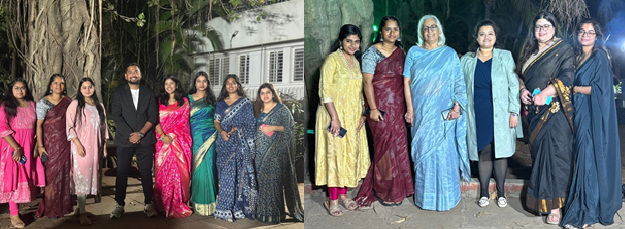
The Alumni Dinner was organized in the evening as the closing engagement of the day, providing an informal setting for alumni, faculty members, and committee representatives to interact and strengthen connections. The event fostered conversations rooted in nostalgia, shared experiences, and the institute’s institutional memory.
The relaxed atmosphere encouraged alumni to reflect on their time at Gokhale Institute of Politics & Economics and engage meaningfully with current students and committee members. The evening concluded with collective photographs, marking a memorable and convivial end to the day’s engagements.