
All That Gold, Yet No Glitter
|
All That Gold, Yet No Glitter
Rangana Guha
B.Sc. Economics (2025-2029)
Estimated Reading Time: 10 minutes
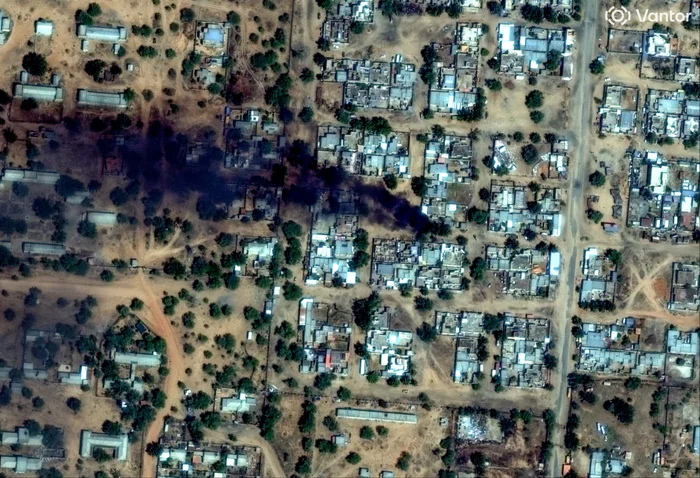
On October 26, 2025, numerous pictures of a blood-stained desert flooded the Internet as satellites picked up images of the bloodied sands of El-Fashir, capital of the North Darfur state.
After a seven-month siege, the Sudanese paramilitary group, Rapid Support Forces (RSF),gained control over the entirety of the Darfur region, slaughtering thousands of people in the process: hospitals were raided to kill patients, people were buried alive, and more were tortured or left for dead.
While estimates for the death toll vary, reports suggest the total number exceeds 500,000, including indirect deaths from disease and famine. The Integrated Food Security Phase Classification (IPC) has also confirmed famine (Phase 5) in multiple regions due to which over 25 million people (half of the Sudanese population) are facing acute hunger. The RSF has been accused of using starvation as a warfare method, blocking aid to consolidate control over fertile farmland. The toll on children is beyond catastrophic. Since the start of the siege in April 2024, over 1100 grave violations have been verified in Al Fasher alone, including the killing and maiming of over 1000 children. Hundreds of thousands have been displaced from Al Fasher and surrounding camps in recent months, and many children remain trapped in Al Fasher in desperate conditions. When it comes to education, over 19 million children are out of school, leaving them vulnerable to exploitation, child labour, gender-based violence, and recruitment into armed groups. With thousands of schools shut, Sudan is experiencing a total collapse of its human capital.
By the end of 2025, Sudan’s GDP is estimated to contract by 42% since the war began. Over 4.6 million jobs have vanished and the national poverty rate has spiked, pushing an additional 7.5 million people below the poverty line.
But what led them to undertake such brutal, heinous abuse? Why the Sudanese people, and why the Darfur region specifically? While the war has been portrayed as purely a byproduct of ethnic or religious divide, the reality differs. Beneath the headlines and news reports is the byproduct of calculated economic competition.
Overview:
Located in the far east of the African continent, Sudan’s geographical position is of significance not only to itself, but also to its neighboring countries and the rest of the continent. To its east lies the Sudanese coastline and Port Sudan, which has access to two critical water points- the Atlantic Ocean to the west and the Red Sea to the east. Port Sudan is particularly important since it has access to the Red Sea trade route, which links Asia with Europe. At the western part of the country lies the Darfur region, an area rich in natural resources such as gold, oil, copper, uranium deposits, and rare earth mineral deposits. The country’s mineral endowments and trade positioning might start putting things together now, with regard to the instability that has taken hold of the nation.
The two main parties at war in Sudan are the Rapid Support Forces (RSF) and theSudanese Armed Forces (SAF). The SAF is Sudan’s official military, which was responsible for enforcing the border, protecting the country from foreign entities, and maintaining internal security, prior to the civil war. The paramilitary RSF was created in 2013 as a rebranding of the Janjaweed Militia. It was created to confront rebel groups and later evolved to become President Omal Al-Bashir’s personal security force.
While the two forces (RSF and SAF) set aside their differences in 2019 to oust Bashir, and again in 2021 to seize power from a civilian government, the alliance frayed over the terms of a planned democratic transition. The central tension was around the integration of the RSF into the official army: the SAF demanded a quick merger to consolidate state control, while RSF leader “Hemedti” sought to maintain control over his force’s independent economic and military power. This disagreement ignited into a full scale, on-going war in April 2023.
The Economics of Tragedy:
Sudan is currently being treated as a bankrupt company whose remaining assets are being picked apart by outsiders. For the RSF, controlling Darfur and the country by extension is about securing resources to fund a paramilitary industrial complex that operates outside of the traditional state.
The primary engine for this economic competition is gold. While the Sudanese economy as a whole has contracted, the informal gold sector has surged. Sudan’s gold production reached an estimated 64 tonnes in 2024, yet only a fraction of that wealth reached the central bank in Port Sudan. The rest flows through a blind spot in the global market: the United Arab Emirates.
This is where the UAE’s role grows more prominent. By providing a permissive environment for the trade of Sudanese gold, Dubai has essentially become a clearinghouse for the RSF’s war effort, and therefore complicit in their atrocities.
The logic behind RSF’s war machine is a cycle of extraction and procurement that effectively bypasses the formal state. It begins at the source, where RSF aligned companies like the US- sanctioned AL-Junaid Company and the Russian-Emirati joint venture Emirati Minerals (Operating through its subsidiary, Alliance for Mining Co. Ltd) monopolize lucrative gold fields in Darfur and South Kordofan. An estimated 90% of this production is smuggled out of Sudan via borders in Chad, Ethiopia, Egypt, and South Sudan to avoid government oversight. This gold eventually reaches refineries in the UAE, where it is laundered into the legal global supply chain. Once converted into legitimate currency in Dubai, the wealth is reinvested into the conflict, fueling the purchase of advanced weaponry including drones and armoured vehicles needed to sustain the ongoing siege in cities such as El- Fashir.
While the gold provides the RSF with liquidity to sustain the current siege, Sudan’s 700km coastline along the Red Sea provides it with strategic capital to control the future. For the UAE, the shoreline is integral to its regional ambitions. By developing state-backed commercial funds like Abu Dhabi (AD) Ports and Dubai Ports World (DP World), the Emirates is attempting to set up a chain of controlled maritime nodes stretching from the Gulf to the Suez Canal.
However, the pursuit for the Sudanese coast has been characterised by persistent tension between foreign corporate interests and Sudanese national sovereignty. Anonymous officials revealed that in 2020, the government was in high level negotiation with DP World to take over the South Port Container Terminal. However, this proposal faced strong opposition from the Sudanese Ports Authority and trade unions, who rejected the idea of private operation of such a critical national asset. Despite this setback, the UAE’s ambition has only grown. In 2022, they proposed the Abu Amama Port Complex, a massive $6 billion project that included a deep-water port and an airport. This deal was however cancelled by the Sudanese government following allegations that the UAE was secretly funnelling weapons to the RSF.
Now, to keep its ammunition secured, the RSF relies on more than just gold. It requires a sophisticated financial system embedded in the global markets. The RSF uses a network of UAE-based shell companies to protect its revenue. Firms like Capital Tap Holding LLC and Python LLC act as financial intermediaries, allowing the RSF to bypass international sanctions and high-tech weaponry.
From an economic perspective, the RSF has successfully de-risked its insurgency by ensnaring its finances in the legal, legitimate commercial world of the UAE. As long as these shell companies are able to trade, the opportunity cost of war remains lower than the price of peace.
What keeps the RSF strong financially is a complex, distributed corporate structure that functions as a transnational procurement arm. Entities such as Capital Tap Holding LLC and Creative Python LLC are financial cutouts that keep the facade of legitimacy to launder millions of dollars through global banks. These aren’t singular, isolated businesses; they’re part of an organised Shadow Economy where a small circle of recurring directors, like Mazin Fadlalla act as bridging nodes. Fadlalla’s history of purchasing hundreds of Toyota vehicles for conversion into mobile machine gun platforms illustrates how these companies turn corporate liquidity into murderous military force on the ground in Darfur.
With its adaptive behaviour, this network acts as an economic marvel and a humanitarian nightmare. The network showed different risk signatures between 2023 and 2025, including Ownership Cycling, in which shareholdings were sold to new proxies a couple days prior to the imposition of international sanctions. This forms a network of strategic redundancy– in case any node is attacked, a replacement company can be set up in a few weeks. These replacement companies tend to have the same digital footprints and office addresses as the prior ones.
The End:
The “efficiency” of RSF’s corporate military network is mirrored by an equally efficient destruction of the Sudanese people. While tonnes of gold flows out of the nation, the Sudanese population is enduring what the UN has labeled the largest humanitarian crisis of the 21st century. The profit being extracted by the UAE-RSF nexus is being stolen directly from the Sudanese people’s future. The opportunity cost here isn’t just a couple years of growth- it is the livelihood of several upcoming generations. For as long as the international community continues to treat Sudan’s gold and coastlines as mere commodities rather than the sovereign property of its people, the violence is bound to continue.
Today, we face a profound market failure: where blood-stained bullion is laundered into clean global systems and where global financial hubs prioritise transaction volume over the ethical integrity of the capital flowing through their markets.