
Cauldron Reached its Boiling Point
|
Cauldron Reached its Boiling Point
Sadhika Mani
B.Sc. Economics (2024-2028)
Reading Time: 6-7 minutes

‘If I had a penny for every instance someone was mauled to death over accusations of witchcraft, I would have no pennies. I’d be penniless!’ the government exclaims as it hides hands that stink of cloying, sweet copper and rust, and mangled bodies behind a big, useless piece of paper that makes a lot of noise when you flap it around.
And before you ask, no, I am not referring to 17th-century America.
43-year-old Gardi Birowa and Mira Birowa, 33, of No. 1 Beloguri Munda village in the Howraghat area of Karbi Anglong, Assam, were found deceased on a Tuesday night in late December of last year, over accusations of using witchcraft to cast misfortune over the village. The couple was said to have been assaulted by sharp weapons before being burned to their demise in their own home.
Was this an event that would normally have an infinitesimal chance of happening in modern-day India?
No! (Quick, act surprised)
For context, Assam has grappled with the violence of witch hunts for ages now, pre-dating the colonial occupation of the state, largely understood to have been a result of long-standing social stigmas and patriarchal structures. Accusations of being a ‘daini’ or a ‘bhutuni’ can emerge from anywhere – a seething neighbor coveting land that is not theirs, being the last person to drink out of a well that caused disease in others, or even sheer spite – and are all, at least in some perspective, valid bases to inflict aggression on an unsuspecting person. Historically, funnily enough, these accusations would only be aimed towards the women, but, and I hope you can tell how glad I am that we’ve progressed so far, they’ve expanded their target pool to children, the elderly, and the mentally ill (and sometimes men).
Which, in short, just means everyone is fair game now.
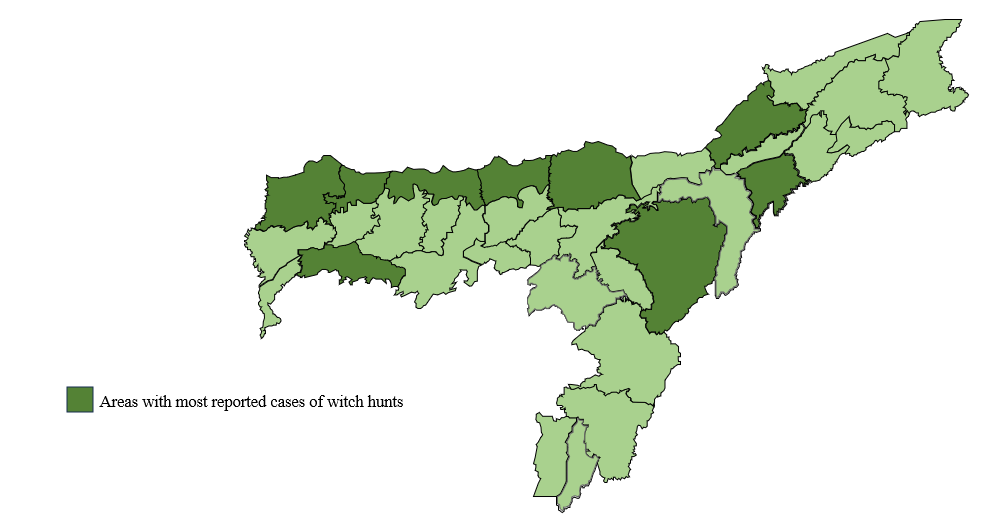
Author’s map based on reported cases
It would do well to establish one crucial fact before looking into how witch hunts are set in motion. While superstition and a lack of education and healthcare definitely drive a lot of the perpetuating practice, it is ALSO mostly fuelled by a lack of media scrutiny and limited state reach due to infrastructural constraints. This is evidently clear from the map, given that the districts that face the most number of cases (and these are just the ones that are reported) exist along the borders of the state, making it difficult for the state government to reach inaccessible areas on time and take any sort of efficient action whatsoever (not that they seem to be trying, given the mounting body count).
Much to my surprise, the government did seem to have ‘tried’. In February of 2015, the Assam Legislative Assembly unanimously passed a bill meant to criminalize witch hunts, imposing severe consequences on those who were charged with taking part in it, making the offense non-bailable and non-compoundable. Were they very successful in accomplishing what the bill was designed to do? Did people magically stop ‘hunting witches’?
Well, yes, but also not really. That’s two different questions, and this is going to take a while. Let’s take a walk.
Firstly, why do rational individuals mobilize for witch hunts when the government has very transparently not sponsored them in any way, shape, or form?
For this answer, we will be referring to the Calculus of Consent by Gordon Tullock and James M. Buchanan, which, in part, speaks of the theory of collective action. One of the main postulates of the very concept of collective action is that when a bunch of individuals share the same objective, they end up forming a group. Consider a hypothetical scenario where a woman has just shifted to a village, and unfortunately for her, her settling in seems to have coincided with a breakout of smallpox. Close-knit rural towns are already normally wary of outsiders, especially one who seems to have brought a disease with her (or so the local medicine man claims). This outlandish claim is accepted and then spread to everyone who lends an ear until all who hear it seem to go along with it and eventually agree.
And then they take the extremely logical and obvious next step of action, which is to form a mob.
Is it a crime to rally against a defenseless woman over baseless claims of something she most definitely didn’t do? Yes.
Do the villagers care? No.
And why is that?
A key feature of collective action is that all the parties involved in this decision-making process bear some cost. The mob’s cost is highly diluted among a large group of people, who decide beforehand not to snitch on each other in case law enforcement comes sniffing around. The brunt of the rest of the cost is borne by the victim and the whistleblowers. It is very possible that not everyone in the village condones such violence and perhaps even wants to speak up about it.
And so you see, the funny thing about bearing the brunt of the cost of a bloodthirsty mob is that if the mob finds it in its purview to hurt you on a suspicion that you have possibly endangered its operations, then you are no longer a whistleblower and just another victim on a very long list.
So even if law enforcement does get there on time (highly unlikely, might I add), there is no one to rat the mob out from within the mob and outside. Victims cannot speak up either, since they risk being further ostracized or assaulted, often forced into agreements with the mob to ensure some amount of security.
To further cement the nature of how difficult it is to hinder a mob when it has already got the ball rolling, let’s examine all the possible outcomes in this situation.
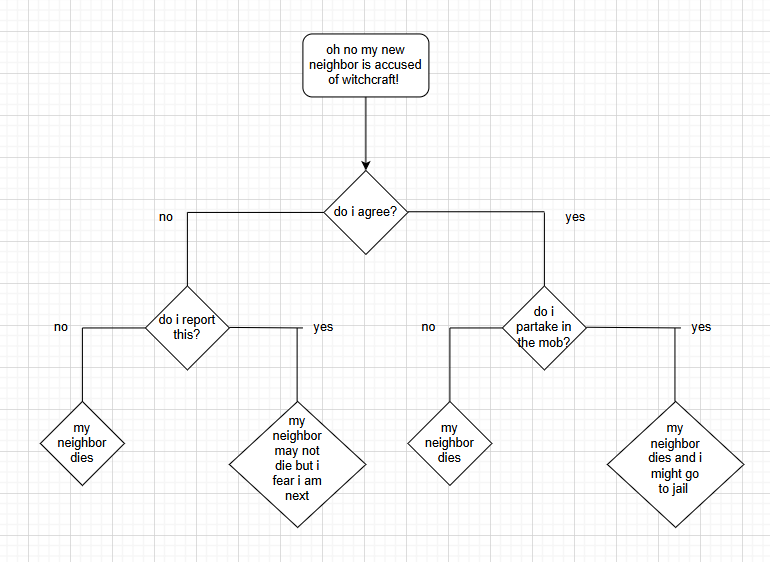
Author’s visualization
The collective outcome in most cases is almost always going to result in the victim facing some amount of harm. This is because there are only two stable equilibria that can exist – one where everyone believes the accusation and the mob forms, or the other where the accusation is rejected, and no violence occurs. Once the first equilibrium is chosen, there is no incentive to deviate from the mob, and the society is stuck in a self-reinforcing cycle. Doubting an accusation privately doesn’t help, and the safest choice is to remain silent. Because whistleblowers and victims are disincentivised from speaking up or testifying, there’s little to no chance of the other equilibrium occurring. Institutional presence would have nullified the mob equilibrium by increasing the cost of being in a mob and protecting whistleblowers. The lack of its presence secures the mob equilibrium
Strictly speaking, yes, but it lacks implementation. It accounts for the risk of coercion by the mob, offering police protection, relocation programs, and financial assistance to victims and whistleblowers, but fails to work properly after any legal process following the recognition of the crime. Victims are often forced into informal agreements to further avoid ostracization, and sometimes even relocate before drawn-out court cases come to even a semblance of assent, with infrastructural and administrative bottlenecks preventing investigations from being conducted thoroughly. The state has made 450 arrests to date, with zero convictions.
If this doesn’t scream ‘flimsy enforcement’, then I don’t know what does.
Law enforcement had one job, and it was to actually be accessible. And maybe while it was at it, it would have done well to change the incentive structure for perpetrators and start prosecuting them. This is where I find that what both the bill and I manage to do exceptionally well is to shove everything under the bed and very loudly say, ‘Hey, I cleaned up!’; succeeding at the performative parts like the arrests and severe penalties on paper, while pending convictions continue to pile up. While this is in no way my condemning the entire purpose and layout of the bill itself, it does leave much to be desired.
On that note, though, I still wish I could forget this bill existed; it’s not doing a lot on its own anyway. I’m going to tuck it away, right next to my gas bill.