Under Graduate

B.Sc. Economics (Data Science) with Apprenticeship-Embedded Degree Programme (AEDP)

The B.Sc. Economics (Data Science) with AEDP is a future-oriented undergraduate programmme that blends core economic theory with modern data science and analytics. Aligned with the National Education Policy (NEP) 2020, this four-year programme is designed to develop graduates capable of analysing complex economic problems using computational and data-driven approaches. By integrating economics with programming, statistics, and artificial intelligence, the programme prepares students to operate effectively in an increasingly digital and data-intensive economic environment.

The curriculum emphasises applying theoretical knowledge to real-world economic and business contexts, enabling students to generate evidence-based insights for policy formulation, strategic decision-making, and economic planning. The apprenticeship-embedded structure ensures that learning extends beyond the classroom, fostering professional competence and industry readiness.
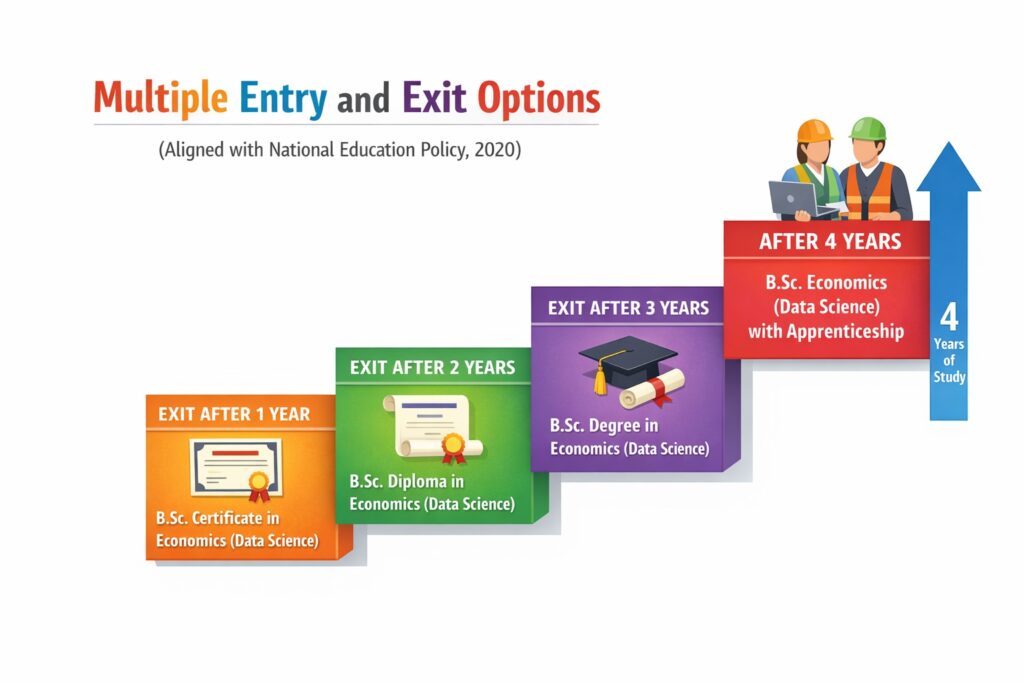
 

Key Features of the Programme:

  • Interdisciplinary Curriculum: Combines rigorous economic theory with data science tools, including R and Python programming, database management systems, machine learning, artificial intelligence, and Generative AI.
  • NEP 2020 Aligned Structure: Designed in accordance with NEP 2020, offering flexibility, skill orientation, and a strong emphasis on employability.
  • Apprenticeship-Embedded Learning: Includes a one-year industry apprenticeship (40 credits) in the final year, providing sustained on-the-job training and real-world exposure.
  • Strong Industry Relevance: Bridges the gap between academic learning and industry expectations by focusing on practical applications in economics and data analytics.
  • Comprehensive Skill Development: Builds strong quantitative reasoning, computational skills, and effective communication abilities.
  • Enhanced Employability: Prepares graduates for careers in finance, market research, public policy, business analytics, and related domains, with hands-on industry experience as a key advantage.
  • Industry-Ready Graduates: Produces professionals capable of applying economic reasoning and data science techniques to address contemporary economic and organisational challenges.

Program Highlights

  • Integrates Economics with Data Science.
  • Covers tools/software like R, Python, AI, ML, and Prompt Engineering.
  • NEP aligned a 4-year undergraduate Degree with an Apprenticeship.
  • One-year compulsory industry apprenticeship in the final year (Semesters 7 & 8).
  • Multiple Entry/Exit Options.
  • Strong foundation in economic theory, quantitative reasoning, and policy analysis.

Program Outcomes:

Disciplinary knowledge: Capable of demonstrating comprehensive knowledge and understanding of one or more disciplines that form a part of an undergraduate /postgraduate program of study.

Communication Skills: Ability to express thoughts and ideas effectively in writing and orally; Communicate with others using appropriate media; confidently share one’s views and express herself/himself; demonstrate the ability to listen carefully, read and write analytically, and present complex information in a clear and concise manner to different groups.

Critical thinking, Problem solving and Analytical reasoning: Capability to apply analytic thought to a body of knowledge; analyses and evaluate evidence, arguments, claims, beliefs on the basis of empirical evidence; identify relevant assumptions or implications; formulate coherent arguments; critically evaluate practices, policies and theories, philosophies.

Acquiring research-related skills, scientific reasoning and reflective thinking: A sense of inquiry and capability for asking relevant/appropriate questions; ability to recognize cause-and-effect relationships, define problems, formulate and test hypotheses, analyses, interpret and draw conclusions from data; ability to plan, execute and report the results of an experiment or investigation.

Employability Options: All the courses along with mandatory apprenticeship aim to bridge the gap between classroom teaching and industry requirements thereby preparing them for roles in diverse financial management, market research, business planning, etc.